The two-day expert conference “Online Identified – Offline Supported: International Impulses for Online/Offline Referral Mechanisms in the Prevention of Extremism” took place on 10 and 11 November 2025 at the Alte Essig-Manufactur in Leipzig. The event was organised by the Advice Centre Saxony in cooperation with the Saxon State Democracy Centre (Landesdemokratiezentrum Sachsen). International and national experts from counselling practice, academia, public authorities and technology companies discussed current global pilot projects on referral mechanisms in the context of preventing online radicalisation.
International Conference Leipzig 2025
Day 1 – Eastern German and International Perspectives
The event was opened with a video message from Petra Köpping (Saxon State Minister for Social Affairs, Health and Social Cohesion). Judy Korn (Co-Founder and Managing Director, Violence Prevention Network) introduced the thematic focus of the conference.
In the first panel, “Between Analysis and Support: Challenges and Solutions in Addressing Online Radicalisation in Germany”, Svetla Koynova (Head of Research Department, Violence Prevention Network), Fabian Starosta (LPR, Exit Programme Saxony), Hanna Börgmann (Research and Education Manager, Institute for Strategic Dialogue – ISD Germany), Maik Fielitz (Head of the Digital Conflicts Research Unit, Institute for Democracy and Civil Society – IDZ Jena) and Wenke Krestin (Head of the Advice Centre Saxony, Violence Prevention Network) discussed scientific findings and practical experiences from counselling and disengagement work in Saxony and eastern Germany.
The second panel, “Stakeholders in Online/Offline Referral Mechanisms and Best Practices in Pilot Projects”, brought together international perspectives. Angus Lindsay (Department of Internal Affairs, Digital Violent Extremism Team, New Zealand), George Weiss (Founder & CEO, La Radio Benevolencija, Netherlands), Georgia Wake (Head of Industry Engagement, Counter-Terrorism Directorate, Home Office, United Kingdom) and Svetla Koynova (Head of Research Department, Violence Prevention Network) discussed requirements and success factors for developing sustainable referral mechanisms.
This was followed by a presentation by Jonathan Russell (Head of International Department, Violence Prevention Network), who introduced Diversions as a global online/offline referral mechanism, providing long-term offline support for individuals whose online behaviour indicates a potential risk of radicalisation. Building on this input, participants discussed the practical transferability of international referral mechanisms to different national and institutional contexts.
At the end of the first day, a third panel focused on “The Involvement of Tech Companies in Tertiary Prevention”. Jonathan Russell (Head of International Department, Violence Prevention Network), Nayanka Paquete Perdigao (Public Policy Manager, TikTok) and Prashant Waikar (Policy Manager, Meta) discussed strategies for preventing extremist content on platforms as well as cooperation models between technology companies and practicioners.
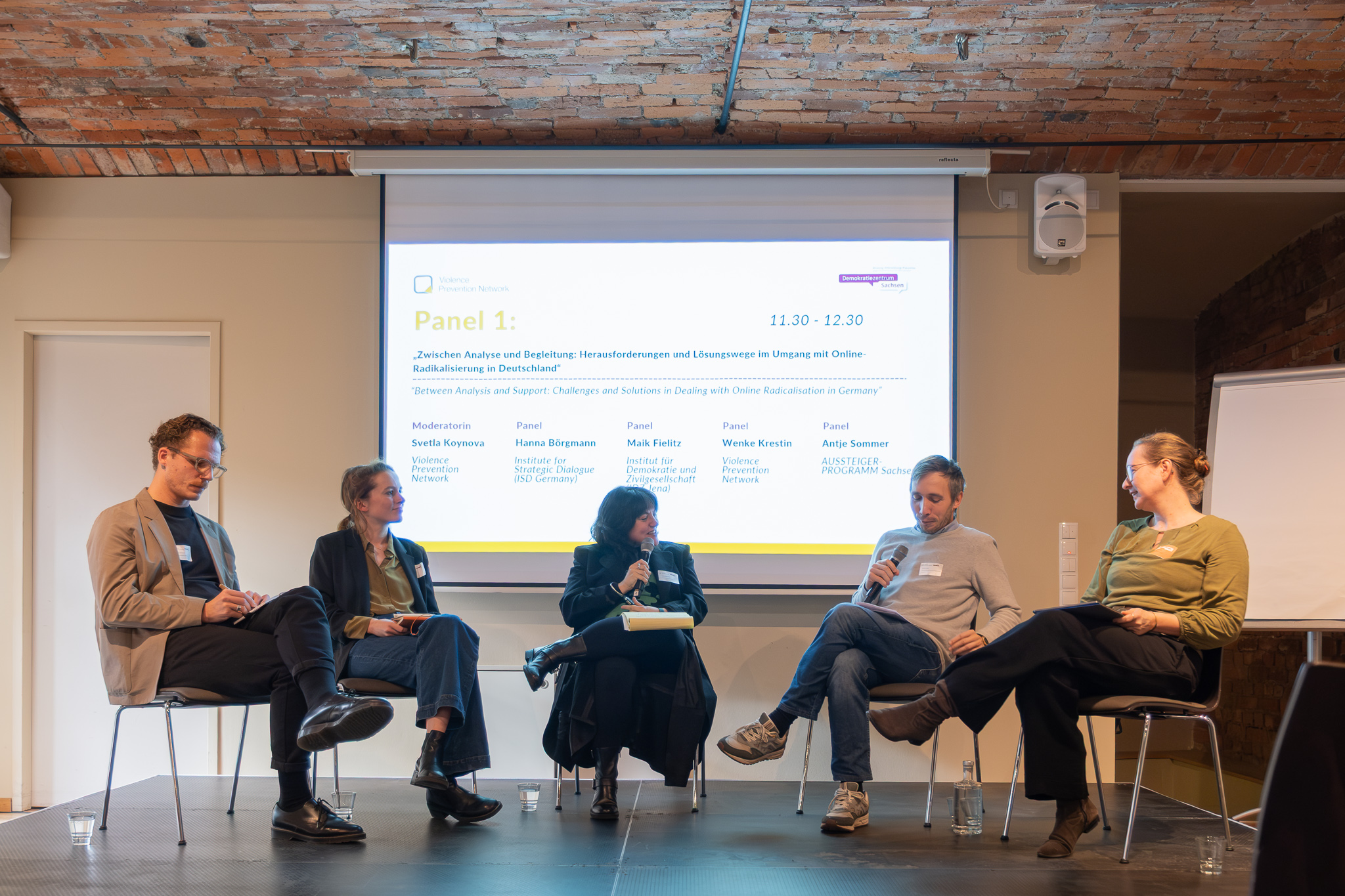
Panel 1 - “Between analysis and support: Challenges and solutions in dealing with online radicalization in Germany”: Participants discuss scientific findings and practical experiences from counseling and disengagement work in Saxony and eastern Germany.

Panel 3 – “Involvement of tech companies in tertiary prevention”: Strategies for preventing extremist content on platforms and opportunities for cooperation between technology companies and prevention actors are discussed.
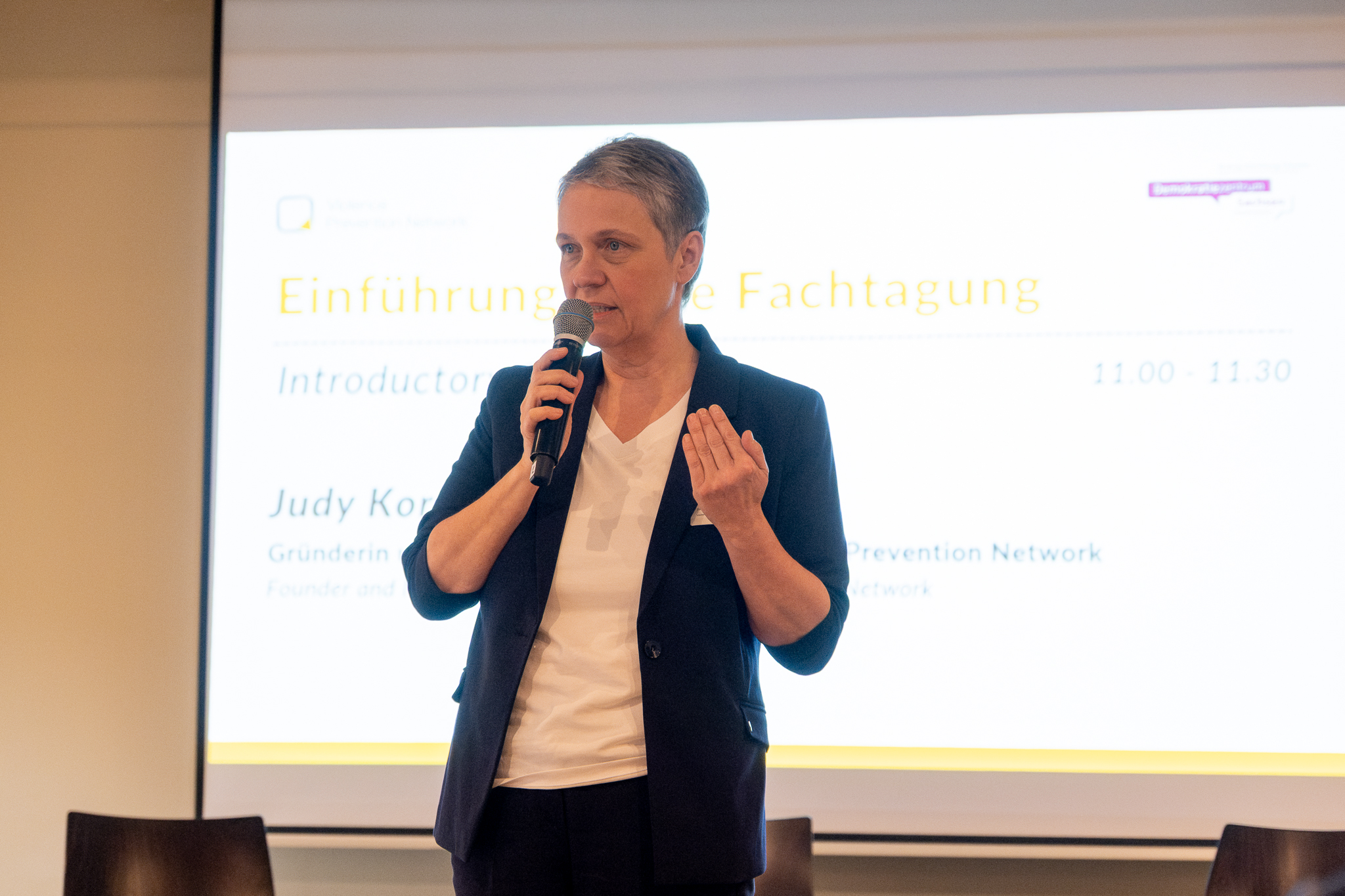
Judy Korn, co-founder and co-executive director of Violence Prevention Network

In small groups, participants discussed the practical transferability of international referral mechanisms to the German context.
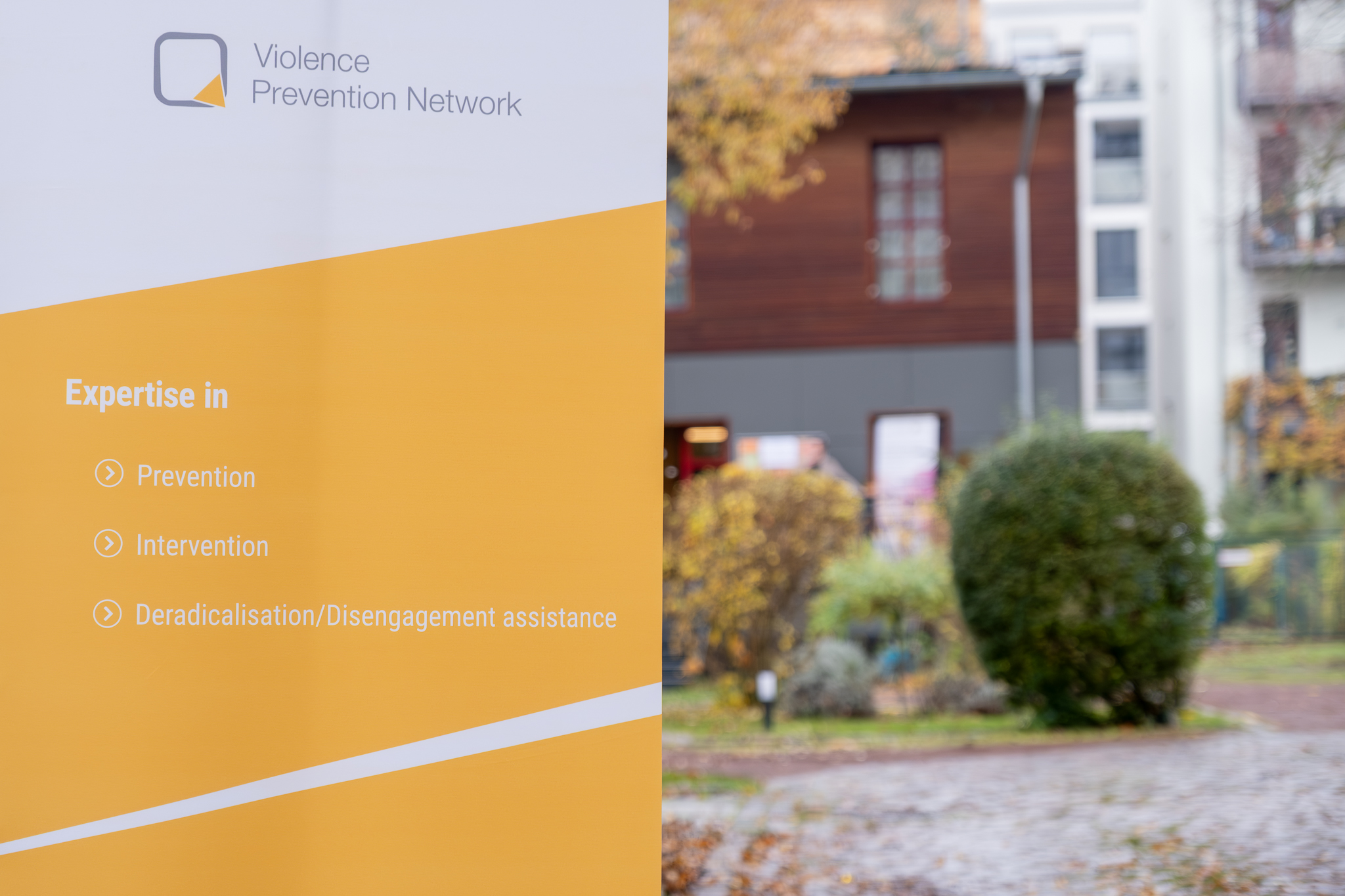
Violence Prevention Network banner in front of the conference venue: the Alte Essig-Manufactur Leipzig
Day 2 – Research and Practice
The second day of the event began with Dr. Nader Hotait (Postdoctoral Researcher, DeZIM Institute and Humboldt University of Berlin), who presented current empirical findings on the dynamics of online radicalisation and discussed their relevance for prevention and counselling practice.
In the subsequent workshop block, “Learning from Mistakes: Finding the Best Solution”, participants explored anonymized case studies from German counselling practice. The workshops were moderated by Navid Wali, Niklas Brinkmöller, Wenke Krestin (Violence Prevention Network) as well as Rosanna Rooke, Dr. Sian Watson and Rachel Handley (CT-ARC, United Kingdom).
Alexander Sievers (Programme Director INDEX and Senior Practitioner, Violence Prevention Network) then introduced the international network INDEX – International Network for Disengagement and Exit. INDEX sets quality standards for disengagement work and strengthens professional exchange among practitioners worldwide.
In the second workshop block, “Practitioners in Online/Offline Referral Mechanisms: Visualising Needs”, the focus was on digital skills development, early warning systems, therapeutic approaches for increasingly online-based client groups and AI-supported tools. The workshops were led by Dr. Kevin Blasiak (Principal Investigator, TU Wien), Julia Nowecki (Director Violence Prevention Network Academy) together with Jacquelyn Muir (Head of Regulatory, Selwyn District Council, New Zealand), as well as Alexander Sievers and Katharina Meredith Sengfelder (Founder, Exit Nexus/PhD Candidate, Georgia State University, USA).
To conclude, Wenke Krestin (Head of Advice Centre Saxony, Violence Prevention Network) summarised the key insights of the conference.
Beyond the conference – What comes next?
Sustainable prevention can only succeed through strong networking between research, practice and technology platforms. To this end, Violence Prevention Network is working on a global network of referral mechanisms: DIVERSIONS – Combatting terrorist use of the internet: online prevention and offline integration.
Are you a counsellor or practitioner? You are invited to engage with INDEX – International Network for Disengagement and Exit, an international network of practitioners that establishes quality standards for disengagement work and facilitates the exchange of expertise.
Contact for further information
INDEX - International Network for Disengagement and Exit
Alt-Reinickendorf 25
D - 13407 Berlin