SCHNITTSTELLE.JUGEND (INTERFACE.YOUTH)

Strengthening professionals at the interface between mental health and radicalisation prevention

Logo des Projekts SCHNITTSTELLE.JUGEND

In recent years, mental health issues among children and young people have increased significantly. At the same time, radicalisation processes are accelerating at an alarming rate, particularly in this age group. Although there is no general causal link between these two developments, complex interactions can arise in practice.

Professionals working in child and youth welfare, extremism prevention and child and youth psychiatry and psychotherapy repeatedly encounter young people who have both mental health problems and extremist attitudes. These cases are highly complex and, in practice, often involve uncertainty and considerable stress.

This is where SCHNITTSTELLE.JUGEND comes in. The aim is to specifically strengthen professionals at the interface between mental health and radicalisation prevention and to increase their confidence in their actions. Through practice-oriented basic training, an interdisciplinary digital evening series and targeted networking initiatives, the project imparts in-depth knowledge about mental health issues and disorders, radicalisation dynamics and professional action in complex case constellations.

The project is being implemented jointly by Violence Prevention Network gGmbH and IFAK e. V. (in the Beratungsnetzwerk Grenzgänger project network) and is funded by the Federal Office for Migration and Refugees (BAMF).
Target groups

The services are aimed at:

  • Child and youth welfare professionals
  • Exit and disengagement counsellors
  • Child and youth psychiatry and psychotherapy professionals

The professions involved take on different, complementary roles in supporting young people. Only through interdisciplinary cooperation can the complex interactions between mental health and radicalisation processes be adequately addressed.

Objectives

SCHNITTSTELLE.JUGEND aims to enable professionals to…

  • recognise and professionally classify mental stress, abnormalities and disorders in children and young people,
  • deal confidently and reflectively with extremist statements, attitudes and radicalisation tendencies in young people,
  • understand the interactions between mental health and radicalisation processes,
  • reflect on their own professional limitations and gain confidence in their actions,
  • identify and communicate appropriate treatment and support structures,
  • establish and utilise local cooperation networks.
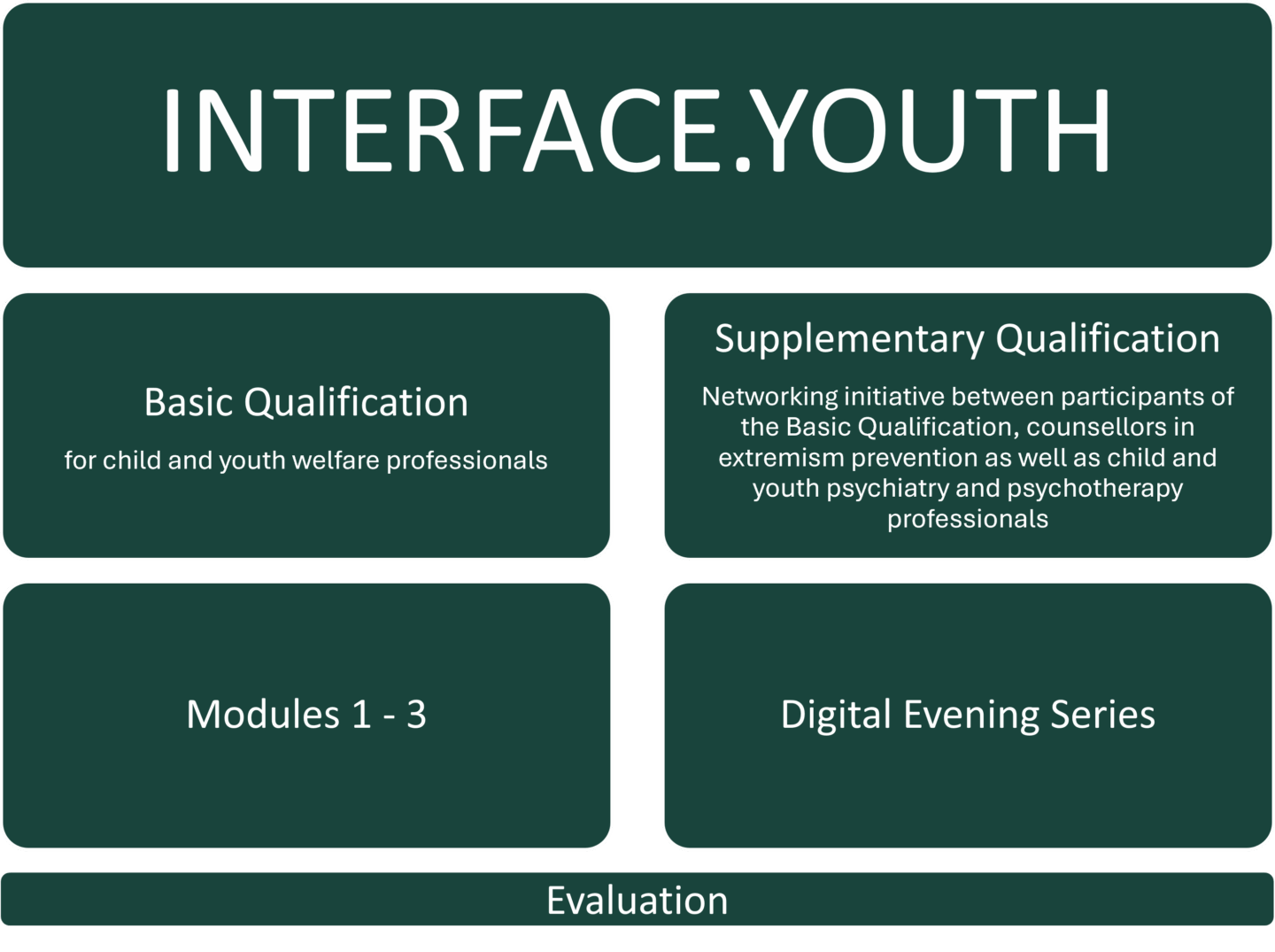
Diagramme titled 'INTERFACE.YOUTH' showing two main qualification blocks labeled 'Basic Qualification for child and youth welfare professionals' and 'Supplementary Qualification Networking initiative between participants of the Basic Qualification, counsellors in extremism prevention as well as child and youth psychiatry and psychotherapy professionals' with two sub-blocks labeled 'Modules 1 - 3' and 'Digital Evening Series' connected to an 'Evaluation' bar at the bottom
Project components

Basic qualification

In three two-day classroom modules, professionals receive a thorough and practical introduction to topics related to mental health, extremism prevention and their intersections. As an introduction, the basic qualification is primarily aimed at professionals working in child and youth welfare.

Module 1

Understanding mental health, radicalisation and distancing – connections, interactions and distinctions


Module 2

Promoting resilience to mental disorders and radicalisation processes


Module 3

Acting in exceptional and crisis situations

The modules combine specialist input, practical exercises, peer consultation and moderated reflection. Case studies from participants serve as a basis for ensuring transfer to everyday working life.


Supplementary qualification: Digital evening series 

The supplementary qualification deepens interdisciplinary cooperation. It serves to specifically connect the participants of the basic qualification with professionals from child and youth welfare, exit and distancing work, and child and youth psychiatry and psychotherapy.

In a modular digital evening series throughout three sessions, keynote speeches and moderated exchange formats are used to address common challenges, responsibilities and opportunities for cooperation. Participants learn about the working methods of other professions and best practice examples of interdisciplinary cooperation. The aim is to initiate local networking initiatives that are necessary for the effective support of children and young people.


Evaluation

The Research Centre for Deradicalisation (FORA) is supporting the project with a process- and results-oriented evaluation. The evaluation serves to ensure quality and the continuous development of the services offered.

Contact

Violence Prevention Network
Project SCHNITTSTELLE.JUGEND
Alt-Reinickendorf 25
D-13407 Berlin

+49 176 5527 9758
Contact

Beratungsnetzwerk Grenzgänger
Project SCHNITTSTELLE.JUGEND
Kortumstr. 106 - 108
D-44787 Bochum

+49 151 1892 7195
The SCHNITTSTELLE.JUGEND project is being implemented in collaboration with IFAK e. V. (as part of the Beratungsnetzwerk Grenzgänger project network) and is funded by the Federal Office for Migration and Refugees (BAMF).